

At On.Top, even in cases of malignant skin tumors that are not melanoma, we offer advanced diagnosis and treatment by both dermatologists and oncologists. Whether it’s basal cell carcinoma (BCC), squamous cell carcinoma (SCC), or Merkel cell carcinoma (MCC), you will receive the highest level of care.
Each year, approximately 10,000 new cases of non-melanoma skin cancer are diagnosed in Israel.
Non-melanoma skin cancer (NMSC) is a group of common skin cancers that do not involve melanocytes (the pigment-producing cells). Although these cancers are usually less aggressive than melanoma, they still require treatment and follow-up to prevent complications, including disfigurement or, in rare cases, life-threatening progression.
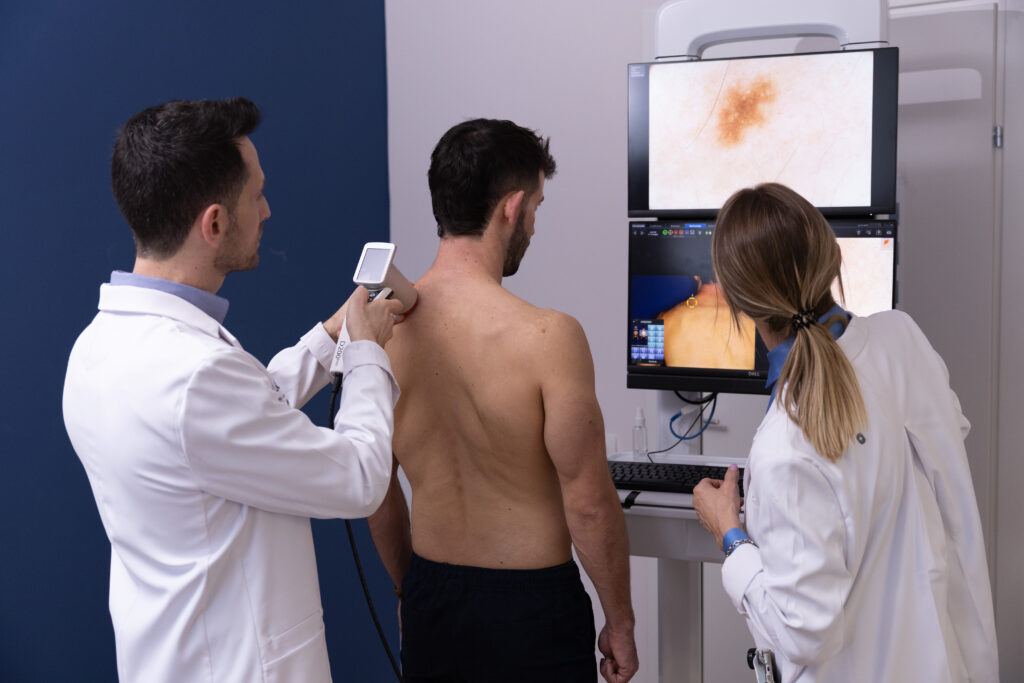
At our center, we use Israel’s most advanced diagnostic and treatment methods to manage the three most common types of NMSC, as well as rarer types of skin cancer:
This is the most common cancer in the world. In most cases, BCC is not life-threatening, and patients recover fully with proper diagnosis and treatment.
It usually appears in sun-exposed areas (head, neck, arms, forearms) as shiny, raised lesions ranging in color from skin-toned to pink. They are often painless and non-itchy but may bleed after minor trauma or spontaneously.
Most BCCs grow slowly and do not metastasize, but they can cause local tissue destruction and aesthetic or functional damage — especially if they affect areas near the eyes or other delicate structures.
Timely diagnosis and proper treatment are therefore very important.
There are rare subtypes of BCC that are more aggressive and can cause significant harm or even become life-threatening without adequate care.
Final diagnosis is made by biopsy. A sample of the lesion is sent for pathological evaluation.
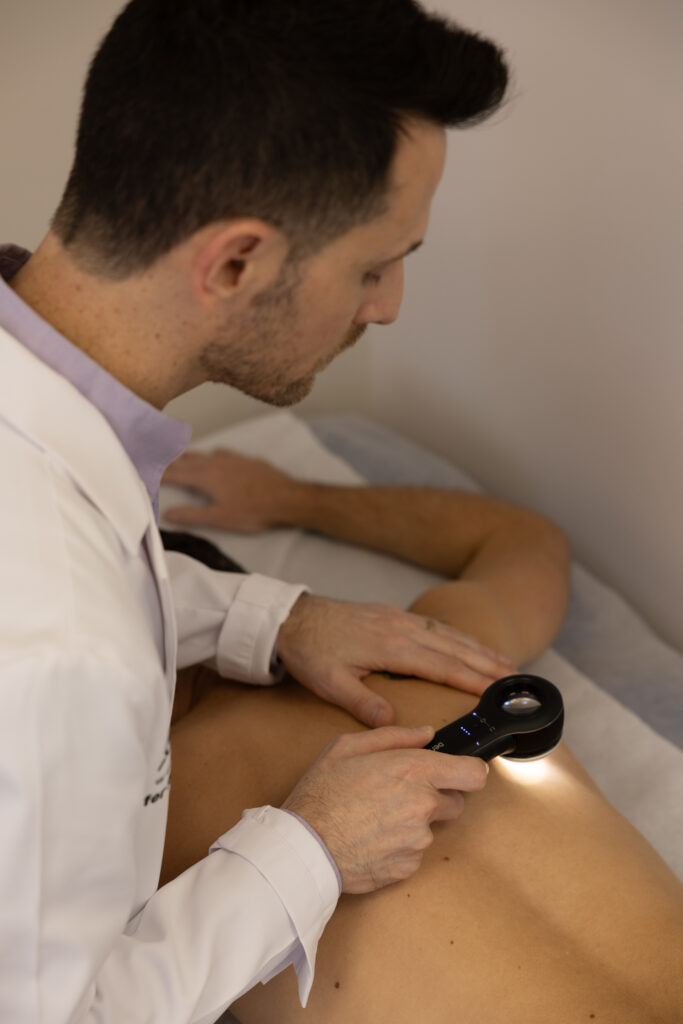
SCC is the second most common type of skin cancer after BCC. Like BCC, it is often curable if diagnosed and treated promptly.
SCC typically presents as thick, scaly lesions with raised edges, or as persistent sores that may bleed or scab. These lesions frequently appear in sun-damaged areas like the scalp, ears, lips, or backs of the hands.
SCC tends to grow faster than BCC and may, in some cases, metastasize to lymph nodes or distant organs such as the lungs or bones.
Final diagnosis is made by biopsy. A sample is sent for pathological confirmation
MCC is a rare but highly aggressive type of skin cancer. Though it accounts for less than 1% of all skin cancers, its incidence has been increasing in recent years.
Early diagnosis is crucial and may be life-saving depending on the stage at which it is detected.
MCC is considered one of the most dangerous skin cancers, due to its rapid growth and tendency to spread to distant organs.
It typically appears as a small (often under 1 cm), firm, and painless skin-colored, reddish, or purple-blue nodule.
It can develop anywhere on the body — not just in sun-exposed areas.
Approximately 50% of cases appear on the head, scalp, or neck, 35% on the arms and legs, and 15% elsewhere.
Risk factors for MCC are similar to other skin cancers, including prolonged UV exposure, and it is more common in people over 60 with fair skin.
Additionally, Merkel cell polyomavirus (MCPyV) has been found in approximately 80% of MCC cases. While this virus is harmless to most, it may contribute to cancer development in immunocompromised individuals.
Final diagnosis is made by biopsy. The sample is evaluated by a pathologist.
In many cases, a sentinel lymph node biopsy is also performed to determine whether the cancer has spread to nearby lymph nodes
Non-melanoma skin cancers are generally less dangerous than melanoma, except in rare cases like MCC.
Precisely because of this, early diagnosis and treatment are essential to prevent avoidable complications and local damage.
With timely intervention, the chances of recovery improve significantly.





At our center, you’ll find a dedicated team of experts — experienced medical professionals focused on the diagnosis and treatment of melanoma and skin cancer, along with an administrative team to support you with all logistics and coordination.
Complete prevention of non-melanoma skin cancers isn’t always possible — especially when the causes are genetic or related to a weakened immune system.
However, most types of skin cancer develop due to environmental factors, especially UV radiation exposure, so preventive measures can significantly reduce your risk.
Adopting a routine of regular check-ups — once a year for those not in a high-risk group, and at least twice a year for those who are — can make the difference between risk and early detection.
Contact us for a check-up and early diagnosis — it’s always better to act early than to regret later.
How Are Basal Cell Carcinoma (BCC) and Squamous Cell Carcinoma (SCC) Treated?
The primary treatment for non-melanoma skin cancers — especially basal cell carcinoma (BCC) and squamous cell carcinoma (SCC) — is surgical removal of the tumor. This can be done either by standard surgical excision with margins of healthy skin, or by Mohs micrographic surgery.
As with any cancer, early detection is key: tumors found in early stages can be removed with minimal surgery, better cosmetic outcomes, and often no need for further treatment.
Alternative treatments have also proven highly effective, particularly when these cancers are diagnosed early. The type of treatment is determined jointly by the center’s physicians — dermatologists and oncologists — and tailored to the patient’s individual needs. The earlier you are evaluated, the better the chances of avoiding more complex treatments.
Non-surgical treatment options include:
When BCC or SCC is diagnosed at a more advanced stage, and surgery or other local treatments are no longer viable, systemic drug therapy may be offered.
This includes:
These medications can be highly effective. Under the guidance of an experienced skin cancer oncologist, treatment can lead to significant results — and in some cases, even a cure.